Santa Muerte in Mexico City: Street Altars and Urban Faith
Discover who Santa Muerte is, where her street altars appear in Mexico City, and how to encounter this devotion respectfully.
People | Feb 03, 2026
Santa Muerte in Mexico City: Street Altars and Urban Faith
Santa Muerte isn’t hidden in Mexico City, but she isn’t advertised either. She is a folk saint devotion centered on death, protection, and survival, practiced quietly across many Mexico City neighborhoods. Her presence lives in small street altars, back rooms, market stalls, and corners where people stop briefly, say nothing, and move on. For many residents, devotion to Santa Muerte isn’t spectacle or rebellion — it’s practical faith in a city that doesn’t always protect you.
What Is Santa Muerte in Mexico City?
Santa Muerte is a non-institutional folk devotion that treats death as a neutral, honest force. In Mexico City, she is honored through street altars, candles, offerings, and personal rituals. Devotion is especially common in working-class neighborhoods and informal economies, where people seek protection, balance, and attention without judgment.
Santa Muerte is not folklore, not a trend, and not a performance for visitors. She is part of daily life for those who turn to her.
Who Santa Muerte Is — and Isn’t
Santa Muerte represents death as something inevitable and impartial. For her devotees, she is not feared — she is trusted.
She is prayed to as:
– A protector
– A listener
– A stabilizing presence
Many people who honor Santa Muerte also identify as Catholic. This devotion doesn’t always replace traditional belief — it often exists alongside it.
Why Santa Muerte Exists in the City
Mexico City is dense, unequal, and unpredictable. Life moves fast, and security isn’t guaranteed. Santa Muerte offers something simple: presence without judgment.
She doesn’t promise miracles. She offers acknowledgment.
This is why devotion appears in places tied to daily risk — markets, transport corridors, street-level businesses, and neighborhoods where survival is negotiated day by day.
Where You Encounter Santa Muerte
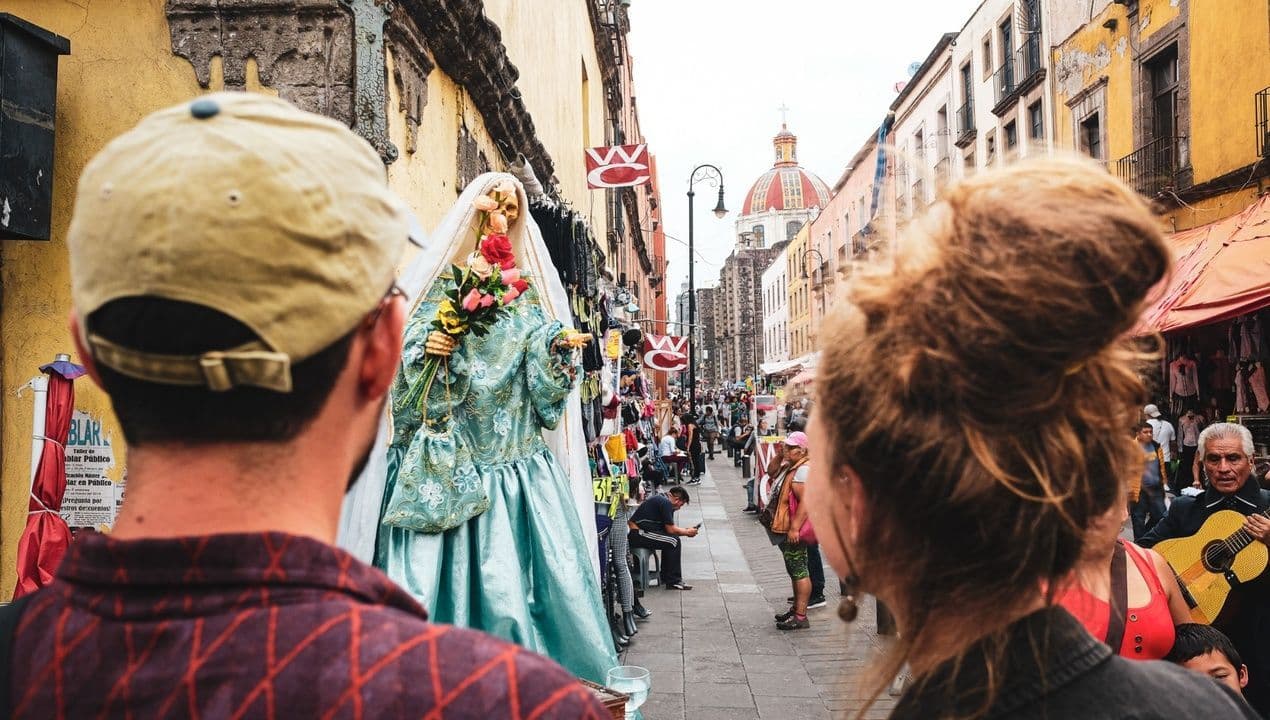
You don’t need addresses or tours to find her. You notice her by paying attention.
– Small altars outside shops
– Candles near street corners
– Figurines beside fruit crates or toolboxes
– Offerings of tequila, cigarettes, flowers, or food
These altars aren’t decorative. They are maintained and used.
The Rituals Are Modest
Most devotion is quiet and brief. People stop, light a candle, touch the altar, and continue on.
Colors matter:
– White for protection
– Red for love
– Gold for work and stability
– Black for boundaries and justice
Rituals adapt to daily needs. There is no fixed script.
What Outsiders Often Get Wrong
Santa Muerte devotion is often sensationalized. Photographing altars without permission or treating them as curiosities misses the point entirely.
This devotion is not a performance. It is a relationship. Understanding that difference is essential.
Santa Muerte and Everyday Life in Mexico City
Santa Muerte devotion in Mexico City reflects how people navigate uncertainty. It exists outside institutions, outside formal approval, and outside spectacle. It fits the city because the city itself is layered, pragmatic, and contradictory.
Faith here is flexible, not doctrinal.
Why This Matters to Travelers
Most visitors experience Mexico City through food, architecture, and museums. Street devotion reveals another layer — how people cope, hope, and negotiate daily life.
It’s not something to consume. It’s something to acknowledge.
How to Encounter Santa Muerte Respectfully
– Don’t photograph altars without permission
– Don’t interrupt someone praying
– Don’t treat devotion as entertainment
– Observe quietly and move on
Respect is the only entry point.
Want Context, Not Spectacle?
If you want to explore Mexico City with context — understanding how food, neighborhoods, belief, and daily life intersect — walking the city with explanation makes all the difference.
That’s the logic behind our Deep Mexico experience: not showing extremes, but explaining reality.
Explore more here: Deep Mexico Tour
Curious about our approach? Visit About Bondabu